How to Write a Great Conference Proposal
Presentation Abstract
Advice from ISSTD Scientific Committee Members
- An abstract should be concise and organized. The abstract should tell a story that flows from beginning to end. An unorganized and difficult-to-follow abstract is one of the most common reasons we cannot adequately evaluate the quality of the abstract, making it less likely to be accepted!
- Be clear about the theories or research that underscore your presentation. We need to understand what led you to the knowledge and ideas that you intend to share with our conference attendees. Are you sharing the work of others? Have you used past clinical approaches to develop your own intervention tool? Tell us the theories (e.g., EMDR, internal family systems, psychodynamic) and research findings, or lack thereof, that led you to your understanding of the topic you intend to present.
- Explicitly state how the presentation furthers our understanding of complex trauma and dissociation. Tell us exactly why you believe the information you plan to present extends what we currently know about the field. Or, if it is summarizing information already known in the field, explain why it warrants being presented at this conference.
- Share your completed abstract with at least two professional colleagues. Ask them whether they can understand your ideas and presentations based on the abstract alone. It is often helpful to get feedback from peers familiar and unfamiliar with your work.
- When relevant, discuss the role of larger systems of harm (e.g., lack of protection of children from childhood abuse, racism against people of color, bias against LGBTQ+ communities). Many of the topics relevant to ISSTD are nested within these larger systems, which play a critical role in shaping the harm and responses to harm in our history. Thus, consider these systems and discuss their role, as relevant to your presentation.
- If anything is unclear in the submission guidelines, ask the conference committee for clarity. We are excited to read the brilliant ideas of our community and members. We offer these guidelines so that you can transform your ideas into acceptable submissions. If you have questions, please contact the conference committee so that we can help you! It will also allow us to make revisions to these guidelines to help more people in the future.
Common Mistakes to Avoid
- Review the sample abstracts below. We provide examples of successful abstracts, along with weakened versions, to scaffold your understanding of what makes an abstract strong. Follow their format to create an outline for your own.
- Don’t assume that readers or reviewers will be familiar with your particular area of work. The reviewers represent a diverse group of people across fields (e.g., psychology, social work, psychiatry, medicine, nursing) and with varying degrees of clinical and research experience. The same is often true at our conference. Therefore, write your abstract in a way that is inclusive to a wide breadth of potential readers.
- Avoid over-stating your findings or potential impact. Try not to over-interpreter the results or make broad claims not supported by your study or presentation. Remain open and curious about your impact rather than making definitive claims that are untrue.
- Be objective. Stick to the facts. Avoid inputting your opinion into the abstract unless you are also providing a research or theoretical justification for doing so.
- Use as few words as necessary to explain your point. We often encounter submissions that use wordy prose or rely on elaborate words and/or sentence structures to make a point that could be more clearly and concisely stated. Use your 300-500 words intentionally. If you do not need the words to make your point, omit them.
- Use inclusive We will not accept proposals that use language that is biased, argumentative, or oppressive.
- Promote open-access science. Our conference values making our field’s knowledge accessible. When possible, avoid a proprietary focus, such as promoting the presenter’s book or a copyrighted technique.
Examples
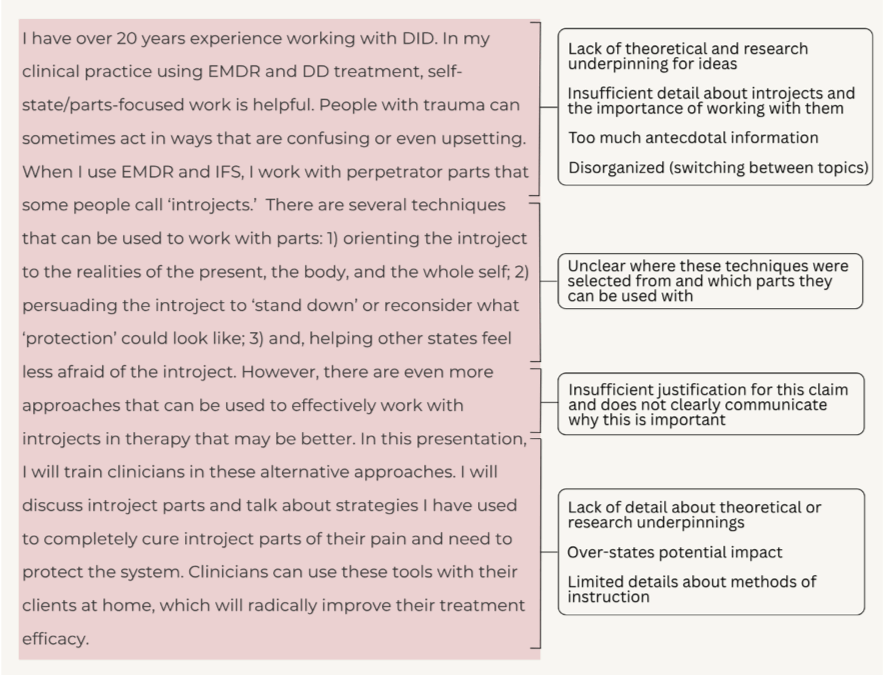
Example 1: Clinical Abstract (3 Hour Workshop, Intermediate)
See below for a sample strong (green) and weakened (red) abstract. The abstracts are examples of the same content/presentation.

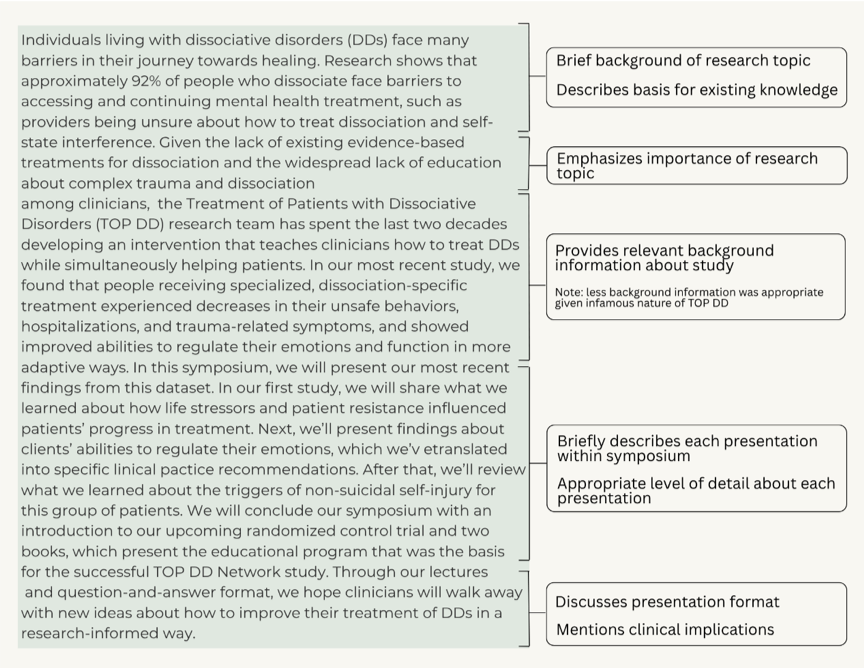
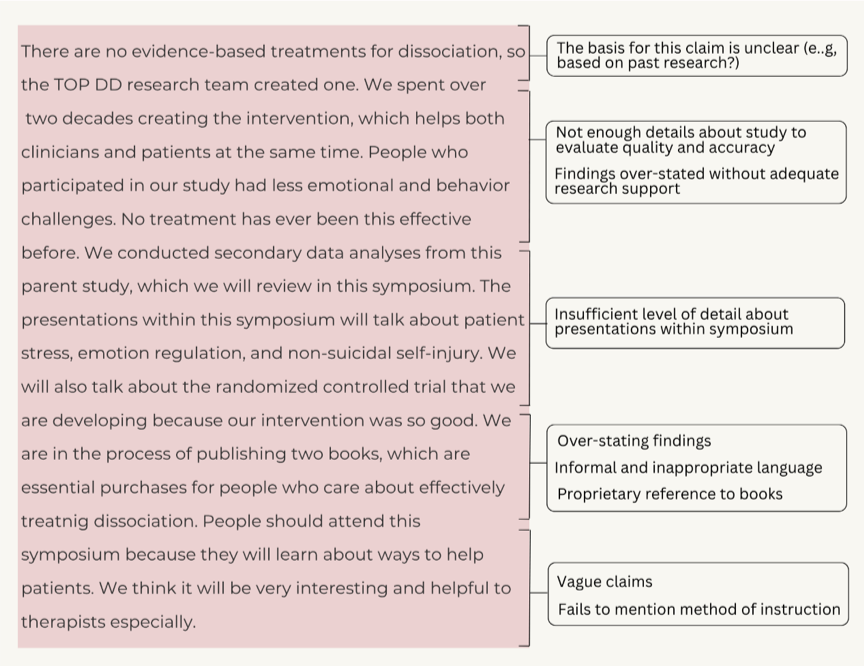
Example 2: Research Abstract (90 Minute Symposium, Overview Abstract, Beginner/Introductory)
See below for a sample strong (green) and weakened (red) abstract. The abstracts are examples of the same content/presentation.
Learning Objectives
Objectives should advise what the participant will be able to do once they have completed a conference session and should be measurable. Please make your objectives as detailed and specific as possible. See APA’s Guidance for Writing Behavioral Learning Objectives for more information.
Strong Examples
- Name three existing approaches to working with perpetrator-identifying self-states.
- Describe two reasons that mapping a client’s self-system early in treatment may be helpful.
- Identify at least two precautions for employing the Introject Decathexis protocol.
- List triggers that lead individuals with dissociative disorders to engage in non-suicidal self-injury.
- Summarize the impact of life stressors and client resistance on treatment outcomes in the TOP DD studies.
- List specific treatment interventions that can be used with individuals struggling with unsafe behaviors
Weak Examples
- Learn about approaches to working with self-states
- Understand why mapping a client’s self-system early in treatment is helpful
- Know at least two precautions for employing the protocol taught in the workshop
- Become familiar with reasons for non-suicidal self-injury
- Appreciate the impact of stressors and resistance in treatment
- Remember treatment interventions based on the symposium content
Presenter Biographies
All presenters are required to submit a 200 to 300 word professional biography written in third person that must include the following information:
- Highest degree including type of degree, major, university and graduation year
- Professional work history
- Summary of publications (if applicable)
- Summary of training completed
- Involvement in ISSTD and other associations
- Awards and designations (if applicable)
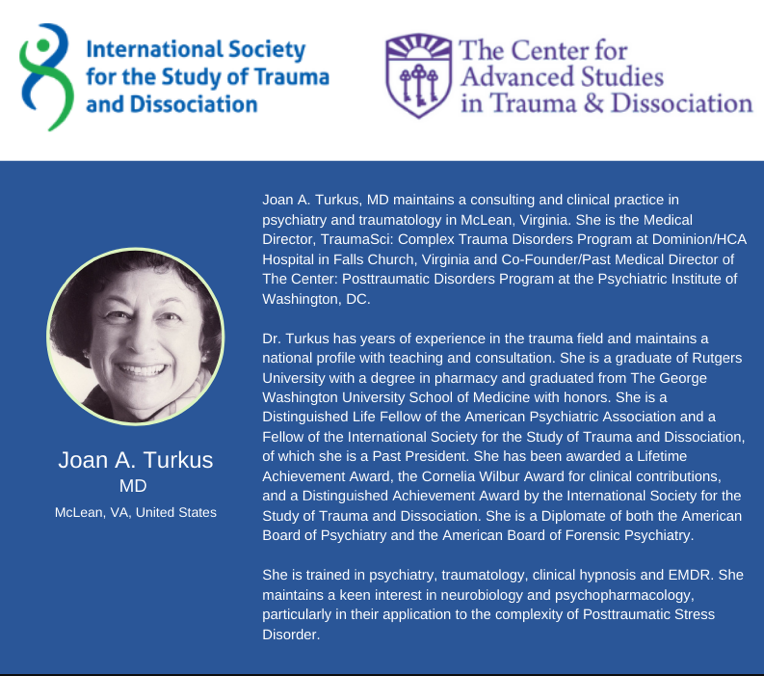
See below for successful examples.
Example 1 (Professional):
Example 2 (Student):
Shae Nester (they/them) is a doctoral student pursuing a Ph.D. in clinical psychology at the University of North Carolina at Greensboro in the USA, where their current research is focused on using experience sampling designs to understand momentary dissociation and interoceptive functioning among trauma survivors. Prior to pursuing their Ph.D., they received their master’s degree in clinical psychology at Towson University in 2021, where they worked in the Treatment of Patients with Dissociative Disorders research lab with Dr. Bethany Brand. Here, their research was primarily focused on non-suicidal self-injury, and the assessment and treatment of dissociative disorders. As part of these research teams, Shae produced close to 20 published manuscripts. They serve as an ongoing research consultant for several external collaborations, including with the United States Department of Veterans Affairs, University of Maryland’s SAFE Center, and Survivor Alliance. They have over 8 years of clinical experience working with trauma survivors, with a particular focus on severe childhood abuse, sex trafficking, and complex dissociative disorders. They currently provide therapy and assessments as the UNCG Psychology Clinic. Shae servers as a member of the ISSTD Scientific Committee and Annual Awards Committee, and was the recipient of the 2023 Outstanding Student Award from ISSTD for their critical contributions to the field of trauma and dissociation.
For a the full guidelines for submissions including the helpful tips from above, please download the ISSTD Presenter Guide created by ISSTD Scientific Committee members Shae Nester and Ruth Blizard.